Does your bioprocess
never quite stabilise?

Download our Problem Map and discover five factors that can compromise reproducibility in bioreactors

We have analysed five factors that can affect reproducibility in bioreactors

01

Gas dosing is not precise enough

02

Process changes go unnoticed

03

Reactors behave differently

04

Ambient conditions affect gas flow

05

The control loop is not properly tuned

Leading biotech companies trust Vögtlin

Discover five factors that can affect your bioprocesses

Please complete the form to access the document.

PROBLEM MAP
Why your bioprocesses never quite stabilise

This field is for validation purposes and should be left unchanged.
The information provided in this form will be stored in our database and and can be forwarded to our sales partners for further processing. Please read our privacy policy for all information about how we protect and manage your submitted data. By submitting this form, I agree that the submitted data may be forwarded to a sales partner for further processing.
Newsletter

What sets Vögtlin apart

Vögtlin smart mixer: O₂ + CO₂ for Photosynthetic cyanobacteria bioreactor systems

No expiration date for your setpoint

Vögtlin uses drift-free MEMS sensors and precise temperature compensation to ensure that a setpoint consistently produces the same physical gas flow.

Petri dish with microorganisms: agar and bacterial colony individually

Gas flow is made visible

Vögtlin displays the actual gas flow in a way that is both visually apparent and digitally accessible, allowing the setpoint, actual value, and system behavior to be checked at any time.
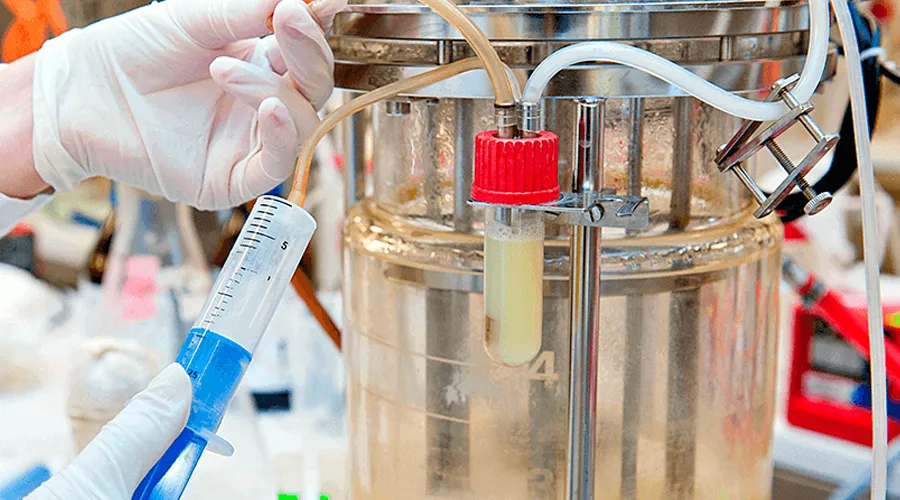
Bioreactor technology: upgrade your gas flow control

No source of uncertainty in the process

Vögtlin combines reliable hardware with fast technical support, calibration services, and long-term support.

Frequently asked questions for biotech professionals

How significant is the effect when operating conditions such as pressure and temperature change?

Thermal mass flow meters and controllers directly measure the number of gas molecules (mass) flowing past the sensor.

This measurement principle allows for large fluctuations in temperature and pressure without significantly affecting the measurement result.

A sophisticated temperature compensation system results in barely measurable differences in the range from 0 to 50°C.

Gases can be compressed. Their volume changes when the temperature and/or pressure change.

Consequently, when specifying a gas volume, the reference temperature and reference pressure must always be specified as well.

Our specifications are based on the requirements of DIN 1343 (standard conditions):

Temperature Tn = 273.15 K, corresponding to 0°C
Pressure Pn = 1013.25 mbar abs
See also: http://de.wikipedia.org/wiki/Normbedingungen

Not everyone understands “standard conditions” in the same way. While there is general agreement on the reference pressure, there are differences regarding the reference temperature:

The U.S. standard liter corresponds to our standard liter according to DIN 1343.
Gas suppliers in Europe specify 15°C rather than 0°C.
To avoid misunderstandings, the reference conditions are clearly stated in our correspondence.
Upon request, we can also supply the devices with a different reference temperature (e.g., based on room temperature of 20°C).

The reference pressure is set to 1013.25 mbar for all units. If, for example, you want to calculate the difference between 0°C and 20°C, the formula is as follows:

(Flow rate at 0°C / 273.15) * 293.15
Example: 100 ln / 273.15 * 293.15 = 107.32 ls
This corresponds to a correction of 0.366% per degree Celsius

We recommend the following calibration interval:

1. Initial inspection after one year

2. After several consecutive calibrations have been performed, the variation from one calibration to the next must be evaluated. Based on this data, a decision can be made to adjust the calibration intervals.

Yes. In many cases, it’s much easier for our service team and for our customers if we can access the customer’s computer directly.

Often, it’s just minor issues that cause devices to malfunction. Please contact us.

Moist gas up to approximately 97% rH has only a minor effect on measurement accuracy. However, appropriate measures must be taken to ensure that no condensate forms inside the measuring instrument.

Condensate accumulates on the sensor and leads to measurement errors. If a measuring instrument has come into contact with condensate, it can usually be purged with a dry gas such as N2. See also the instructions in the user manual.